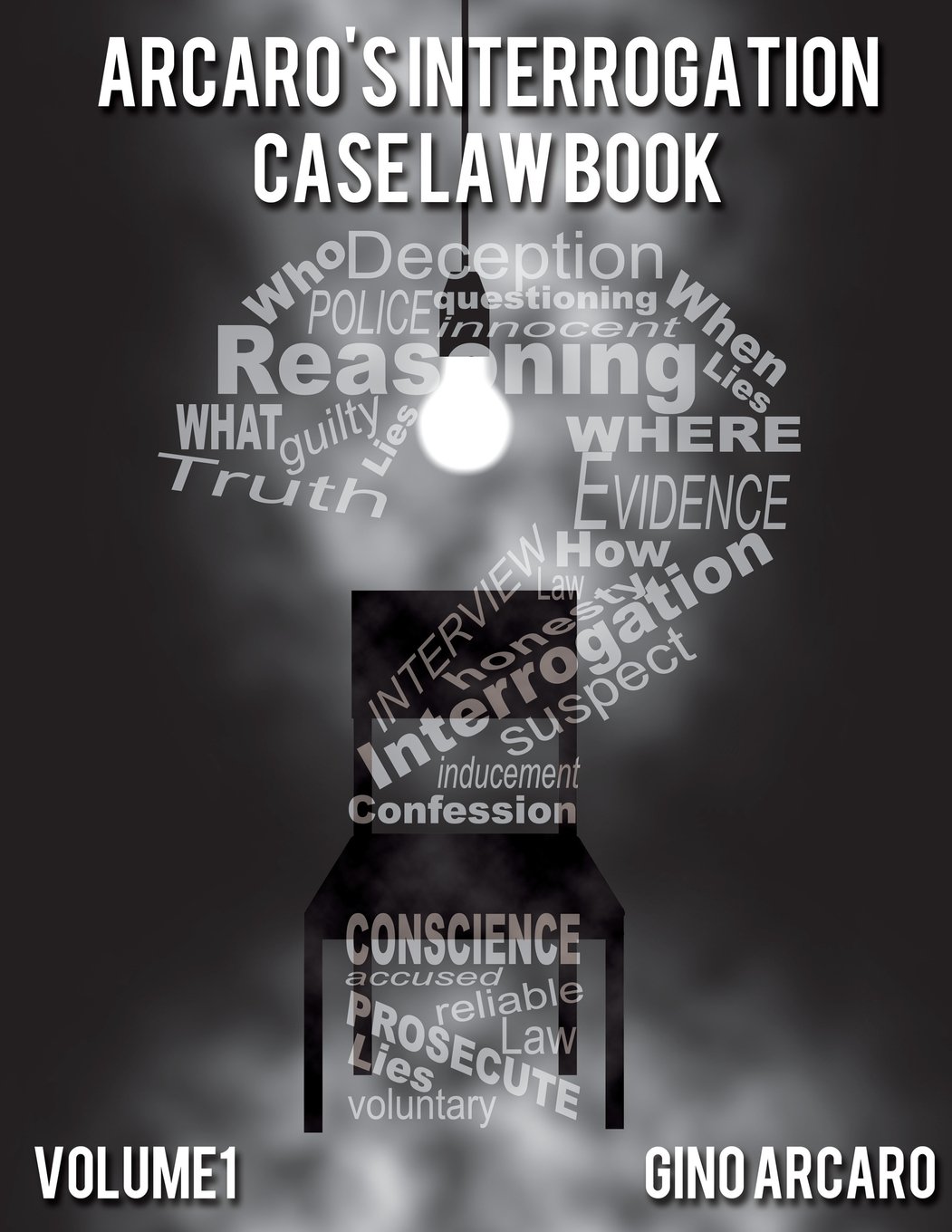
Arcaro’s Interrogation Case Law Book
The Canadian Confessions Rule, Voluntariness and Police Interrogation Law, Organised as Working Procedure for Investigators, Recruits and Police Foundations Students

Book Overview & Core Value Proposition
A true, admissible confession is valuable evidence. Getting one is not a matter of instinct, and keeping it is not a matter of luck. Arcaro's Interrogation Case Law Book sets out the Canadian law on interrogation and the admissibility of statements as working procedure, so an investigator can question a suspect and know the statement will stand up on a voir dire. The book opens with the basics: the rules of evidence on adult confession admissibility and the Truth Test, the history of how the confessions rule took its present shape, and the evidentiary strength of a confession when forming reasonable grounds. It then works through R. v. Oickle (2000) S.C.C. as the point-of-reference case, covering the circumstances of the interrogation itself and the contemporary confessions rule the Supreme Court built from it, framed around one purpose: preventing forced and false confessions. The centre of the book is the four Force Factors a court examines when voluntariness is in dispute. Threats or promises and improper inducements, across two chapters and an Inducement Chart. Oppression. The operating mind requirement. Other police trickery. Each factor closes with its own conclusion, so a specific challenge can be worked through on its own. The book ends on false confessions, and on caution and videotape as the two supplements of proving voluntary. The case law is organised by issue rather than by date, so a problem can be looked up during preparation rather than read end to end. At 122 pages it is a working reference, not a textbook. This is Volume 1 in Gino Arcaro's interrogation series. Developing interrogation skill does not just happen. It takes practical experience and training, and it takes knowing exactly where the line sits before you walk into the room.
“The Canadian Confessions Rule, Voluntariness and Police Interrogation Law, Organised as Working Procedure for Investigators, Recruits and Police Foundations Students”
Key Takeaways (Benefits for Officers & Students)
The Limits of Police Deception
What courts have allowed, what they have called an abuse of process, and the line that cannot be crossed in the interview room.
Oppression and the Operating Mind
How interview length, conditions and a suspect's capacity are assessed, and what the notes must show to answer the challenge.
Threats, Promises and Inducements
Where a lawful offer ends and an inducement begins, with the wording that has cost the Crown statements in court.
The Voluntariness Test, Step by Step
The four areas a court examines, set out in the order an investigator works through them before and during an interview.
Caution and Videotape as Proof of Voluntary
The two supplements the Crown relies on to discharge its burden, and what each one has to show before a court will accept the statement.
Curriculum Breakdown & Table of Contents (Module View)
The book opens with ten points that frame everything after it, built on one idea: interrogation comes down to conscience. This module explains why there is no interrogation rulebook or playbook in the Criminal Code, why confessions do not just happen, and why the way to weaken the defence is to score points. It covers the author's reason for using the word interrogation instead of interview, and search instead of elicit, and closes on the difference between success and failure being what is given up.
The foundation layer. Triple Play, the language of confession law, and Basic Confession Rules of Evidence 101 with the practical translation that follows it. This module covers the Rules of Evidence on adult confession admissibility and the Truth Test, the history of the confessions rule and how it arrived at its present form, and the evidentiary strength of a confession when forming reasonable grounds. It is the part a recruit or a police foundations student reads first, because nothing later in the book makes sense without it.
A full working translation of the governing authority. The module sets out the circumstances of the Oickle case and the interrogation itself, then draws out the interrogation issues the Supreme Court identified. It then turns to the second half of the judgment, the contemporary confessions rule, and the Court's stated purpose in shaping it: preventing forced and false confessions. This is the case every voluntariness argument is measured against, read here as practical procedure rather than as a judgment to be summarised.
The operational core of the book. Force Factor 1 covers threats or promises and improper inducements, across two chapters, the second built around the Inducement Chart. Force Factor 2 covers oppression. Force Factor 3 covers the operating mind requirement. Force Factor 4 covers other police trickery. Each factor ends with its own conclusion, so an investigator can work through one factor in isolation when a specific challenge is coming. These are the four areas a court actually examines when voluntariness is in dispute.
The closing module pulls the four force factors back into the Supreme Court's own summary of the contemporary confessions rule. It then deals with false confessions and why the rule exists to prevent them. The final chapter covers caution and videotape as the two supplements of proving voluntary, which is where law meets daily practice in the interview room. The volume closes by returning to where Chapter Zero began.
Target Audience (Who Needs This Manual)
| Audience Segment | Primary Practical Benefit | Application |
|---|---|---|
Police Foundations Students | Plain-language case law that matches what is tested on interrogation and admissibility | Course study and exam preparation |
Police Recruits and Patrol Officers | Knowing the line before the interview, not after the statement is challenged | Pre-interview preparation and note taking |
Detectives and Major Case Investigators | Issue-by-issue lookup of the authority that governs a specific problem in a live file | Case preparation and Crown brief support |
Case preparation and Crown brief support | A structured framework for teaching voluntariness without wading through full judgments | Classroom and in-service training delivery |
About Author Gino Arcaro

Gino Arcaro
Author, Former Police Detective, SWAT Officer & Criminal Justice Professor
Gino Arcaro is an accomplished author, former police detective, and veteran college professor of law enforcement and criminal justice. With decades of hands-on experience in high-stakes criminal investigations and police education, Arcaro designed this manual to resolve the recurring documentation and procedural pitfalls that compromise criminal prosecutions. His teaching frameworks have educated generations of Canadian police recruits, seasoned investigators, and criminal justice professionals.
Book Specifications
Official bibliographic metadata and publication technical details.
More in Law Enforcement
True Confessions: How to get the Truth (Blunt Talk)
Using Leon Festinger’s theories of cognitive dissonance, Gino Arcaro relates a simple fact often minimalized by truth-seekers, but in reality the key to obtaining a confession: “Everyone has a conscience. No exceptions. If you’re alive, you have a conscience. The myth of ‘no conscience’ actually means weak or dysfunctional conscience.” He further explains that a strong conscience is an interviewer’s best partner because it activates the compulsion to confess. “You can’t hide from inner demons; they have to be released. The power of a strong conscience has limitless lifting capacity. Appealing to the conscience means make the conscience functional and work. Triple meaning: make it work out, make it work right, and make it do all the work.” Arcaro, a former police detective, combines his practical experience with solid studies on the human condition, producing an easily understood manual for anyone whose job it is to get the truth. A simple application of Arcaro’s strategies is in the Human Resources field, specifically during the job interview process. Law enforcement interviewers will also see True Confessions as a valuable tool – one that gives them a window into the psyche of a suspect under interrogation.
Criminal Investigation: Forming Reasonable Grounds (Sixth Edition, 2024)
The Definitive Field & Courtroom Operational Reference for Canadian Police Officers, Major Case Detectives, and Police Foundations Students
Basic Police Powers: Arrest and Search Procedures, 4th Edition
Basic Police Powers: Arrest and Search Procedures, 4th Edition
Frequently Asked Questions
Everything you need to know about purchasing, shipping, and reading Arcaro’s Interrogation Case Law Book.